As with everything in this world writing is evolving, relatively recently this thing called the internet came about and did all these crazy things to writing. This, internet has caused writing to have accelerated change most notably in way it is produced, how it is targeted and how it generates revenue. The future holds great things for electronic writing, it will become completely user based and as a result the internet will hold more valuable information than society has ever had access to before.
Right now there are sites for scholarly research papers that are completely user based. Anyone can submit a paper they have created that has value to the site. That does not mean that your submission will go through to become part of the online journal though. For most of these online journals, the paper must go through a vigorous peer review process that will deem if it is of high enough quality to become a part of the journal. The journal of musical research online covers a wide range of topics that have to do with music. They are user based and take papers from anyone that joins the site, the sites policy is that “Papers submitted for publication will be reviewed by two peers and only those papers of the highest international scholarly standards will be accepted for publication”
What the future holds for scholarly papers is a little different. There will be a main site, like Wikipedia, for almost all of the scholarly papers. It will have a very effective peer review system, in this peer review system the paper will have to pass higher and higher quality standards increasing in expectation as the peers that review it become more experienced and qualified. The peers will not only sort the papers by quality they will also sort the papers by readability, significance, interest and other things that could be important. Then the papers will be divided into tiers and categories on the site, the quality standards test will only decide what tier it goes on, while the readability and interest tests will determine if the paper goes to a more generally public accessible part of the site or a part that mostly scientists read. The importance will have to do with how much the article is displayed on the site and possibly if it goes on the front page. This system will effectively sort the papers that people create to share information or theories with others. It can be modified to sort most anything and similar systems will sort the electronic writing on other user based sites on the web.
Right now revenue has become somewhat of a problem for most newspapers that have converted into websites. They have had trouble making money off of online ads because they are not targeted well enough and they don’t make enough money off of clicks. Online visitors are not as valuable as print ones because they tend not to read everything in depth on the page according to Paul Farhi . Another reason that newspapers aren’t making as much as they used to is because of the loss of classified advertisers. With the advent of Craigslist, where people can post their items for free and to a bigger audience, newspapers have been losing more classified advertisers every year.
In the future of electronic writing, advertisements will be targeted better so that they can generate more revenue for the companies that buy them, then they will pay the sites with the advertisements more. The ways in which ads will be made more effective is that they advertisements will be targeted more to the readers needs. If an article is about cooking the advertisements will usually have something to do with that. The cookies that are installed on your browser will also keep track at what you look at and what you like and advertise to you based on that. They already do that now on certain sites to a small degree, but in the future the extent to which they are targeted will be extremely advanced. Say you’re a good online shopper and you know where to find the best prices and you buy the parts to make a subwoofer off a site like parts-express.com. Other sites may see that you know what you are doing and that you are trying to get the best prices and they will be able to create deals that will be tailored to take your business away from parts-express.com they won’t just drop the price below the competition to take away your business from the other site because that would easily be exploited. They would show you a price on the parts for some tweeters or some midrange speakers with a plan already created on how to create them that would make it so that you wouldn’t have to calculate the volume needed in the housing for the speaker. This is an extremely specific example but you could see how it would work in other cases.
Another trend that has been happening on the internet and that has started with photos, is the automatic combination of information to create a larger more detailed picture. There is a site and program called photosynth created by Microsoft that takes pictures from users of the same place or object and combines them to create a more detailed picture that can be almost 3-d if there are enough pictures. In the not so distant future, the earth will be almost entirely recorded in pictures and on a service like Google Earth you will be able to zoom in on ANY permanent or semi-permanent object or place and be able to see it in detail from ANY angle. Why stop at pictures, if you are looking at an object that is usually moving you will be able to pull up a video on it on the spot if you feel like watching it in motion. Tourism will probably be affected but that’s for another essay. This sounds freakishly amazing but photosynth/ is a great proof of concept, I recommend that you check it out to see what I am talking about.
In the future of writing this same concept will be applied. Programs will be made that will gather the writing on the internet and link it all together. If you are reading an article and don’t know the word, right click and find the definition, if you are reading a fictional story that parodies a certain event, there’s the summary of the event , if you are reading about Kanye West and want to say what’s up, there’s his phone number. Another thing that will happen is that the people who are linked to can pay to be linked more often and the sites that are linked from can charge a small amount of money for every reader they send the sites way as another small form of revenue. In the very distant future it’s possible that the programs will aggregate all the info on the web and turn it into articles on different things. Actually you would be able to choose any subject you are interested in and any length for the article and the page would synthesize an article for you to read based on that information.
If user based sites want to be used by many people and have lots of quality content then they must find a way to motivate the users to create the traffic and the content. Sure user based sites work great now but they can usually have parts that are unreliable. One thing that must be done is that the users must have a system like the one I described above to regulate the power and make sure that the best users gain the most power in the system. But the best way to motivate someone to do a good job is to pay them. There are many ways that sites could pay their users in the future but the best way would be by number of page visits or even better by paying them a percentage of the income they generate to the site from the money generating methods I described above. It wouldn’t be shocking if many sites didn’t just make the content creating jobs user based but the entire site, including programmers and people who coordinate the advertising. There would have to be a few head people who could strip the power from any user if they got out of control or abused the system. But if they were paid they would most likely know the consequences of their actions and not want to lose a source of revenue.
With the advancement of technology it seems like privacy will get violated very badly all the time. Anyone will be able to look up information on you whenever, sure you could make a system to keep peoples information safe but there are ways around that. If people want to find your information badly enough they probably will be able to. Celebrities will probably be affected the most, and will have a very hard time keeping their personal information private. People will have to become more comfortable about their information being out and outlooks will have to change.
In the future the community will reign. They will create the greatest source information that history has ever seen and they will do it because technology is making it easier to combine our efforts than ever. With this easy access of all this information the world will start to change but in what way is anyone’s guess.
Friday, December 5, 2008

"Joe the Electronic Author" and "The Future of Electronic Writing"
In the last decade electronic writing has become the best way to send and find information on the internet. The convenience of going online and searching for information about anything or anyone cannot be matched, that is unless you really enjoy huge encyclopedia text books. However the credibility of online information can easily be argued. Today source websites like, Wikipedia and various Blogsites can be easily altered, allowing any average Joe to have his own say in the information given. If the holders of information switch from those who are qualified to those who just want a hobby, then the internet can no longer be a credible source. Soon our top Bloggers will be the award winning authors of tomorrow.
In today's society most youth and college student rely on the internet to help source there papers and essay's. One of the most popular sight used is wikipedia. Wikipedia is sourced by the public, meaning no one has to approve its content. Many times the information on the page is not given by a "professional" on the topic, but rather someone who just fills as if they can contribute. This makes it hard for some people to take wikipedia as a credible source.
In Actuality wikipedia is the prime example of efficient electronic writing in the future. Everyday thousands of people log on to wikipedia to check the recent post and edit anything they feel is inaccurate. Its as if the whole world got the chance to proof read one essay. Also every wiki-page comes with a list of all the references or links used in the article. If there are no links on the page wikipedia will notify you before you begin reading. This actually insures that the best information is given to you.
This semester Professor Fox's Electronic writing class was given the opportunity to write there own blogs. They chose there own topic's and released information either based on there own knowledge of it or just from other internet sources. This was a prime example of how electronic writing is changing writing as a whole. No one in that class could say they were professionals in there field but instead could say they had a passion for it and wanted to provide information to others who shared that same feeling. Todays top blogsites are rarely made by professional authors, professors, or doctors. Instead they are produced by the public; your everyday "average Joe".
With the future of writing moving into the internet, soon you will no longer need to go to the library to find a book, the internet is one giant online library. This will take away from the most establish Authors who make money of there book sales. There is no more need to go to the library when you can access thousands of sources 24/7 online. However what many people claim is most important about the library is that it holds professional books, newspapers, magazines, and other sources that have been edited and reviewed before they were published. Also they have librarians who can help you locate a source if you need help. The internet on the other hand provides a full multimedia perspective, offering videos, audio, hyperlinks, text, and pictures all in one place. The biggest fault about a library is that resources can be checked out, publications may not be up to date, and worst of all it closes after hours.
Many journalists claim that bloggers are not credible sources because the only regurgitate news given from the mainstream. According to Drunk Jays Fan's blog, in regard to sport bloggers, "bloggers are nothing but fans because they repeat the information they read in the newspaper". He calls them hacks because they create there own sources and not many people can tell the difference. However if you look at there information, and filter it through your own you are only going to have a better understanding of it.
Regardless of your view on electronic writing, the reality is that we are moving into the age of convenience. No longer are students researching in the library to find there sources when every source they need is a mouse click away. Electronic writing just like other forms of writing has its flaws but its still in its early stages and with the ability to be edited by the public its only going to become more efficient. Authors are still going to be looked upon for there expertise on a situation but now with the help of blogging people can look beyond the conventional authors, and professor, and get an opinion the everyday "average Joe's"
In today's society most youth and college student rely on the internet to help source there papers and essay's. One of the most popular sight used is wikipedia. Wikipedia is sourced by the public, meaning no one has to approve its content. Many times the information on the page is not given by a "professional" on the topic, but rather someone who just fills as if they can contribute. This makes it hard for some people to take wikipedia as a credible source.
In Actuality wikipedia is the prime example of efficient electronic writing in the future. Everyday thousands of people log on to wikipedia to check the recent post and edit anything they feel is inaccurate. Its as if the whole world got the chance to proof read one essay. Also every wiki-page comes with a list of all the references or links used in the article. If there are no links on the page wikipedia will notify you before you begin reading. This actually insures that the best information is given to you.
This semester Professor Fox's Electronic writing class was given the opportunity to write there own blogs. They chose there own topic's and released information either based on there own knowledge of it or just from other internet sources. This was a prime example of how electronic writing is changing writing as a whole. No one in that class could say they were professionals in there field but instead could say they had a passion for it and wanted to provide information to others who shared that same feeling. Todays top blogsites are rarely made by professional authors, professors, or doctors. Instead they are produced by the public; your everyday "average Joe".
With the future of writing moving into the internet, soon you will no longer need to go to the library to find a book, the internet is one giant online library. This will take away from the most establish Authors who make money of there book sales. There is no more need to go to the library when you can access thousands of sources 24/7 online. However what many people claim is most important about the library is that it holds professional books, newspapers, magazines, and other sources that have been edited and reviewed before they were published. Also they have librarians who can help you locate a source if you need help. The internet on the other hand provides a full multimedia perspective, offering videos, audio, hyperlinks, text, and pictures all in one place. The biggest fault about a library is that resources can be checked out, publications may not be up to date, and worst of all it closes after hours.
Many journalists claim that bloggers are not credible sources because the only regurgitate news given from the mainstream. According to Drunk Jays Fan's blog, in regard to sport bloggers, "bloggers are nothing but fans because they repeat the information they read in the newspaper". He calls them hacks because they create there own sources and not many people can tell the difference. However if you look at there information, and filter it through your own you are only going to have a better understanding of it.
Regardless of your view on electronic writing, the reality is that we are moving into the age of convenience. No longer are students researching in the library to find there sources when every source they need is a mouse click away. Electronic writing just like other forms of writing has its flaws but its still in its early stages and with the ability to be edited by the public its only going to become more efficient. Authors are still going to be looked upon for there expertise on a situation but now with the help of blogging people can look beyond the conventional authors, and professor, and get an opinion the everyday "average Joe's"
Blogs Become Art
Tea leaves and crystal orbs offer no insight into the future of “electronic writing” – more specifically, the future of blogging. Current hands can shape bloggings future – mold rather than predict their future. Its shape influences other arts like music. Eventually blogging will be recognized as an art form, but only after the reader has “died”. When the generation of people who were alive when blogging was created die out and only those who were raised with it are living – that will be the time when people will look past blogging as only journal entries or news, and will also see them as art.
Dear reader, an explanation of, “after the reader has died” - it should be construed literally and metaphorically. Blogs have created a new interaction between the writer and reader. What is written can be immediately commented upon, edited grammatically and factually, linked and responded to; “The reader can interact with the text on an immediate, physical level; roles of writers and readers thus become unclear.” The reader becomes writer when they leave a comment or post a rebuttal/response blog. Usually the author will read these comments and respond – for a short while the writer is reader.
While the reader will eventually die, the difference between reader and writer will never completely disappear. The writer is becoming more prominent, as seen in the creation of blogs, but regardless of how popular blogging becomes the role of reader will never disintegrate entirely. Those who are blogging must have an audience to prompt further work, and those wishing to improve their writing will always be reading whom they admire or hear great things about.
The blurring between reader and writer has already occurred in music between the audience and performer. For the debut of John Cage’s 4’33, the performer sat down at the piano, closed the lid to signal the first movement, and sat there “silently” for the remainder of the piece. While the performer sat tacit, the sound of the audiences breathing, coughing, whispers, the noise from the building, and from outside all contributed to the composition. The audience, environment, and anything that made noise were the performer and created the music. This blurring is occurring in other musical relationships as well.
Innovations and trends that occur in literature and art (painting, sculpture, etc) are usually followed by music. For example, the Romantic Period in literature started in 1776, but it did not occur in music till somewhere around 1810-1820. Impressionism in painting occurred around the 1860’s, followed by literature, then music. The changes that blogging have caused, blurring the distinction between reader and writer, have begun to occur between composer and performer with the invention of interactive electronic music.
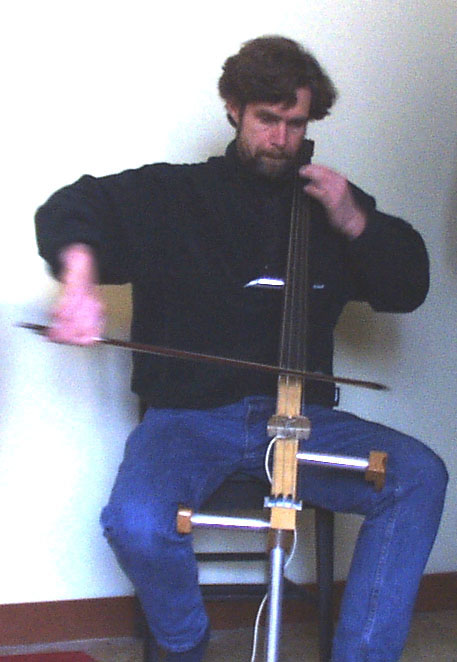
This type of composition almost completely breaches the boundary between composer and performer. Generally, “the composer creates the blueprint for a piece of music which includes software that reacts to the input of the live performer.” An example of this is Chris Chafe’s piece “Push-Pull”. He invented an interactive electronic version of the cello, known as the celletto, which has to be patched into a speaker, computer, or other electronic device to make sound. It uses a remote sensor called the “Lightning Rod”, which attaches to the performers wrist or elbow, that interprets the motion occurring inside its field and enables the synthesizer, computer, or whatever electronic device is chosen to be the “cellists” accompanist, to react. The software is able to react in real-time as if it were a person performing. Chafe used a chaos theory algorithm so every time the piece is played it is different. This blurring between reader and writer, composer and performer, is very recent and has much more room for development.
Currently blogs are already used as a medium to post established art forms like poetry, short stories, continuous stories, films, etc. But they will become their own form of art – they already are. Writing a blog is simply writing, but on-line. An excellent writer creates a work of art when they write an excellent blog. An excellent blogger combines great writing with pithiness, links, audio, and video that add to the content - but future bloggers will take this further.
Many blogs have a beautiful background or are “framed” by an image. To show an event or to help express a feeling bloggers can easily insert pictures. Some blogs are made almost entirely of pictures. Although bloggers could take a different route – instead of using the same background or .gif to ornament their blog and make it cute each different blog post could use a painting or photo, of their own or someone else’s creation, to help evoke their thoughts, moods, and feelings.
But a good writer gets their point across without using a picture; they paint with words. This is what will help differentiate between a well-written and artistic blog versus one that uses pictures and videos to substitute the mediocre written content. For a blog to be considered art in the future it will have to incorporate pictures and other multimedia. An “artistic” blog will contain original content - those written in response to another blog or that report the news will not be included in the genre.
Even when there is a new generation of writers and readers a problem exists for blogs being perceived as an art form - how temporal they are. Written and broad-casted news are not seen as an art form because they are always changing – every day the news is different. Regardless of how well written or brilliant an article is the next day it will be replaced by a new one. Blogs are similar to news because they change on a daily basis. Some political blogs are updated every few minutes.
But future generations will be used to everything being available instantaneously and changing quickly. Unless it is discovered in the future that the internet and cell phones cause caner the use of these tools will continue and become further integrated into society – new generations will have been raised with this technology. This is partly why future generations will be able to accept blogs as an art form – they will recognize that art does not have to transcend time.
Why is something only considered art unless it lasts “forever”? Paintings do not last forever; their colors fade and grime corrodes them. Statues that have been partly destroyed are considered even more artistic. Music itself is a temporal art – each note lasts for a few moments. Even recordings can only be listened to for so long. Tolstoy wrote, “Art is a human activity consisting in this, that one man consciously, by means of certain external signs, hands on to others feelings he has lived through, and that other people are infected by these feelings and also experience them.” Art is a sincere thought or feeling portrayed by the artist so that others can feel it as well. Does this portrayal have to last for some time? News is about news - it reports what happens daily, but blogs are different.
Blogs sometimes report the news, are thoughtful comments upon the news, or having nothing to do with the news at all. They should not suffer under the same stigma as the news. Blogs may be just as temporal in some instances, but the content is vastly different. Some are informative about a certain topic, offer reviews, stories, or journals, etc. There is much more room for creativity in blogging – anything can be written about and any type of media can be included. The only way a blog is limited is by dimensions and perhaps future technologies will bridge this gap (imagine a holograph to view the internet with).
The art form of blogging already exists; it is only a matter of time before it is acknowledged. Libraries can help speed up this process, if in the future they keep a record of blogs. Like pottery found on an archeological site can tell its peoples history, blogs tell ours. Examples of something similar are the Vanderbilt Television News Archive, Google News Archive, and Archive.org. Vanderbilt University has been recording news broadcasts since August 5, 1968 and loaning them to the public for a fee. Google Archive and archive.org do the same thing, only for free, with websites. They save the site and make it available after it has been removed or edited. But neither of these on-line archives has a blog section.
Libraries will make up for this shocking lack by making blogs available to search and reference through their computers and websites on-line. Similar to the Vanderbilt Project, there will be huge amounts of data to save including text, pictures, audio, and video files. If bloggers incorporate visual art into their writing, choosing between saving the entire page or just the text - simply choosing which blogs to save will be difficult. There are already millions of blogs on-line, and there is no obstacle to inhibit the creation of more as time progresses. But by using virtualized servers libraries would be able to store all the data. They could organize blogs into certain categories, and use a search crawler similar to Google’s to make searching for information fast and simple.
But which blogs should be saved? If libraries simply want to record history then it would be appropriate to save political blogs, ones about current events, and those written for a newspaper. But blogs are not simply historical, many offer information people could reference. Libraries will probably also record research blogs, ones that are informative on a certain topic, those kept by famous people, etc, so that people could search through these as well. Personal and family “journal” blogs would most likely be left out – unless if someone decided it was important to save these so that future generations could look back and see what their ancestors wrote.
By recording blogs libraries would turn them into something permanent. While blogs should not have to be permanent to be considered an art form, this will erase the problem for those who do not understand or agree. While the creation of the Vanderbilt News Archive has not made our generation consider news as an art form that is because, once again, news only reports daily occurrences. Blogs can be written about anything, and the ones that are not written about the news will have the capacity to be seen as something artistic.
Whether or not blogs are seen as art or if interactive electronic composition takes over the concert halls will all depend on the people of today. Previous generations choices shape their progeny’s society. By accepting blogs as an art form now, instead of waiting till the current readers all die, we allow future generations to toy and take these ideas even further. Help shape the future - write an artistic blog!
Dear reader, an explanation of, “after the reader has died” - it should be construed literally and metaphorically. Blogs have created a new interaction between the writer and reader. What is written can be immediately commented upon, edited grammatically and factually, linked and responded to; “The reader can interact with the text on an immediate, physical level; roles of writers and readers thus become unclear.” The reader becomes writer when they leave a comment or post a rebuttal/response blog. Usually the author will read these comments and respond – for a short while the writer is reader.
While the reader will eventually die, the difference between reader and writer will never completely disappear. The writer is becoming more prominent, as seen in the creation of blogs, but regardless of how popular blogging becomes the role of reader will never disintegrate entirely. Those who are blogging must have an audience to prompt further work, and those wishing to improve their writing will always be reading whom they admire or hear great things about.
The blurring between reader and writer has already occurred in music between the audience and performer. For the debut of John Cage’s 4’33, the performer sat down at the piano, closed the lid to signal the first movement, and sat there “silently” for the remainder of the piece. While the performer sat tacit, the sound of the audiences breathing, coughing, whispers, the noise from the building, and from outside all contributed to the composition. The audience, environment, and anything that made noise were the performer and created the music. This blurring is occurring in other musical relationships as well.
Innovations and trends that occur in literature and art (painting, sculpture, etc) are usually followed by music. For example, the Romantic Period in literature started in 1776, but it did not occur in music till somewhere around 1810-1820. Impressionism in painting occurred around the 1860’s, followed by literature, then music. The changes that blogging have caused, blurring the distinction between reader and writer, have begun to occur between composer and performer with the invention of interactive electronic music.
This type of composition almost completely breaches the boundary between composer and performer. Generally, “the composer creates the blueprint for a piece of music which includes software that reacts to the input of the live performer.” An example of this is Chris Chafe’s piece “Push-Pull”. He invented an interactive electronic version of the cello, known as the celletto, which has to be patched into a speaker, computer, or other electronic device to make sound. It uses a remote sensor called the “Lightning Rod”, which attaches to the performers wrist or elbow, that interprets the motion occurring inside its field and enables the synthesizer, computer, or whatever electronic device is chosen to be the “cellists” accompanist, to react. The software is able to react in real-time as if it were a person performing. Chafe used a chaos theory algorithm so every time the piece is played it is different. This blurring between reader and writer, composer and performer, is very recent and has much more room for development.
Currently blogs are already used as a medium to post established art forms like poetry, short stories, continuous stories, films, etc. But they will become their own form of art – they already are. Writing a blog is simply writing, but on-line. An excellent writer creates a work of art when they write an excellent blog. An excellent blogger combines great writing with pithiness, links, audio, and video that add to the content - but future bloggers will take this further.
Many blogs have a beautiful background or are “framed” by an image. To show an event or to help express a feeling bloggers can easily insert pictures. Some blogs are made almost entirely of pictures. Although bloggers could take a different route – instead of using the same background or .gif to ornament their blog and make it cute each different blog post could use a painting or photo, of their own or someone else’s creation, to help evoke their thoughts, moods, and feelings.
But a good writer gets their point across without using a picture; they paint with words. This is what will help differentiate between a well-written and artistic blog versus one that uses pictures and videos to substitute the mediocre written content. For a blog to be considered art in the future it will have to incorporate pictures and other multimedia. An “artistic” blog will contain original content - those written in response to another blog or that report the news will not be included in the genre.
Even when there is a new generation of writers and readers a problem exists for blogs being perceived as an art form - how temporal they are. Written and broad-casted news are not seen as an art form because they are always changing – every day the news is different. Regardless of how well written or brilliant an article is the next day it will be replaced by a new one. Blogs are similar to news because they change on a daily basis. Some political blogs are updated every few minutes.
But future generations will be used to everything being available instantaneously and changing quickly. Unless it is discovered in the future that the internet and cell phones cause caner the use of these tools will continue and become further integrated into society – new generations will have been raised with this technology. This is partly why future generations will be able to accept blogs as an art form – they will recognize that art does not have to transcend time.
Why is something only considered art unless it lasts “forever”? Paintings do not last forever; their colors fade and grime corrodes them. Statues that have been partly destroyed are considered even more artistic. Music itself is a temporal art – each note lasts for a few moments. Even recordings can only be listened to for so long. Tolstoy wrote, “Art is a human activity consisting in this, that one man consciously, by means of certain external signs, hands on to others feelings he has lived through, and that other people are infected by these feelings and also experience them.” Art is a sincere thought or feeling portrayed by the artist so that others can feel it as well. Does this portrayal have to last for some time? News is about news - it reports what happens daily, but blogs are different.
Blogs sometimes report the news, are thoughtful comments upon the news, or having nothing to do with the news at all. They should not suffer under the same stigma as the news. Blogs may be just as temporal in some instances, but the content is vastly different. Some are informative about a certain topic, offer reviews, stories, or journals, etc. There is much more room for creativity in blogging – anything can be written about and any type of media can be included. The only way a blog is limited is by dimensions and perhaps future technologies will bridge this gap (imagine a holograph to view the internet with).

The art form of blogging already exists; it is only a matter of time before it is acknowledged. Libraries can help speed up this process, if in the future they keep a record of blogs. Like pottery found on an archeological site can tell its peoples history, blogs tell ours. Examples of something similar are the Vanderbilt Television News Archive, Google News Archive, and Archive.org. Vanderbilt University has been recording news broadcasts since August 5, 1968 and loaning them to the public for a fee. Google Archive and archive.org do the same thing, only for free, with websites. They save the site and make it available after it has been removed or edited. But neither of these on-line archives has a blog section.
Libraries will make up for this shocking lack by making blogs available to search and reference through their computers and websites on-line. Similar to the Vanderbilt Project, there will be huge amounts of data to save including text, pictures, audio, and video files. If bloggers incorporate visual art into their writing, choosing between saving the entire page or just the text - simply choosing which blogs to save will be difficult. There are already millions of blogs on-line, and there is no obstacle to inhibit the creation of more as time progresses. But by using virtualized servers libraries would be able to store all the data. They could organize blogs into certain categories, and use a search crawler similar to Google’s to make searching for information fast and simple.
But which blogs should be saved? If libraries simply want to record history then it would be appropriate to save political blogs, ones about current events, and those written for a newspaper. But blogs are not simply historical, many offer information people could reference. Libraries will probably also record research blogs, ones that are informative on a certain topic, those kept by famous people, etc, so that people could search through these as well. Personal and family “journal” blogs would most likely be left out – unless if someone decided it was important to save these so that future generations could look back and see what their ancestors wrote.
By recording blogs libraries would turn them into something permanent. While blogs should not have to be permanent to be considered an art form, this will erase the problem for those who do not understand or agree. While the creation of the Vanderbilt News Archive has not made our generation consider news as an art form that is because, once again, news only reports daily occurrences. Blogs can be written about anything, and the ones that are not written about the news will have the capacity to be seen as something artistic.
Whether or not blogs are seen as art or if interactive electronic composition takes over the concert halls will all depend on the people of today. Previous generations choices shape their progeny’s society. By accepting blogs as an art form now, instead of waiting till the current readers all die, we allow future generations to toy and take these ideas even further. Help shape the future - write an artistic blog!
Something for the History Books
Computer technology has taken enormous leaps of advancement from where it once was, decades ago. Computers and the internet have changed the world dramatically in a couple decades. Technology is always evolving, getting better and running faster. The internet allowed people to upload information, which most people in the world can see. This was the catalyst for the movement called electronic writing. Electronic writing in the future will have to separate itself from print in order to succeed, for only the strongest survive. The future of electronic writing is directed towards communication with others, and educating people.
Social Networking will become a primary way for people to communicate. Social networks allow people to express themselves online. These social networks target teenagers, because this demographic group prefers to always be in touch with their friends. Social networks allow people to share photos, plan events, and stay connected. There are roughly 65 million people who own a facebook account according to the article Controlling Access for Social Networking. In the future, everyone who has internet access will have a social networking account. This is because social networks allow people to communicate periodically and conveniently. Writing on social networks is convenient because it allows users to leave messages, updates and news through a user friendly network, in which people can periodically check if they have internet access. Writing on social networks involves leaving posts, commenting on pictures or videos, updating events or creating groups. The future of social networks will allow people to do much more on the web site. This allows people to expand their writing experience by writing on new subjects. Writing on a social network is similar to writing on an email. People converted to using email faster than any other form of communication besides talking of course. When writing an email or on a social network, one can be formal or casual depending on the recipient. Emails in the future will not change much because they are simple and efficient. The only flaw with emails is that information cannot be exchanged fast enough, but that’s why instant messengers were developed.
Instant messaging and text messages are also ways people communicate with writing. Instant messaging is growing now and will become one of the most popular ways to communicate. Sometimes people need information immediately and cannot wait for people to check their emails, so they instant message the person instead. This allows people to commutate in a conversation format. The difference between talking on the phone and using an instant messenger is that people, who talk with their voice, can only do so much without the conversation going stale. Were as with instant messengers, people can do several things at once, and the conversation can continue; this is called multi-tasking. Instant messaging has potential to become the primary means of communication. The future of instant messaging looks bright because of recent innovations such as file sharing. Writing on instant messengers will continue for a long period of time. Text messaging has the same characteristics as the instant messenger, but in a mobile phone. Writing on instant messaging and text messages is much different that writing papers. Writing styles online will broaden from casual slang to professional looking documents. Currently, a large portion of the population writes online with abbreviations, writes in slang, and or litters the page in smilies or other symbols. People suggest that this will change how people write in print, but it will not because students are educated enough to know the difference between a casual conversation online and a term paper. People use abbreviations because they are too lazy to type out the entire word. Although this may sound terrible, it really has no effect on how students write their papers. Students will catch any mistakes when editing, thus the problem is solved. The future of online writing will make way for both casual conversations and formal papers turned in via internet.
New advances in technology allow students to be schooled from home via internet. The future of electronic writing involves having students write and turn papers in online. Some schools already incorporate this technology, while most others use the more conventional paper essays. Both have their own advantages and disadvantages. For example, turning in papers online saves the environment, allows a broader audience to read and or grade the work, and is more convenient for the professor to receive. On the other hand, turning papers online makes it easier for people to plagiarize, professor cannot make notes on the paper as easily and you need internet connection to submit the essay. It would be easier to plagiarize because there would be more essays online for the general public to view on blogs and other websites. There are websites that prevent plagiarism such as turnitin.com. To plagiarize is defined as “to steal and pass off (the ideas or words of another) as one’s own”. Students know that it is risky to plagiarize online because turnitin has “created a series of computer programs to monitor the recycling of research papers”. These programs have slowed the cheating process down but have not eliminated it. Future programs will become smarter and will be able to detect paraphrased information. Writing online in the future will eventually become the primary means of writing. This is because of the technology to stop plagiarism, the convenience of the internet and because of the broader audience who cans see the paper.
Although there are plenty of educational websites, they will never replace textbooks or the classroom. Classrooms have the personal communication and interactive lessons that the internet does not. Text books are more useful because one can highlight and make notes on the margins and mark pages, while online writing has far less of those capabilities. Also, books have a sense of nostalgia because they have been around for so long. They can be taken anywhere, and they do not need internet or battery to access them. Also they do not strain one’s eyes after reading for a period of time. They are something that will never be replaced. There are sites online such as Write It that allow students to “read and critique works-in-progress, publish their writing online, learn techniques from featured writers, and expand their creativity with interactive writing activities”. Even future sites will not surpass the classroom and it’s because there is an interactive connection between the teacher and the student. Online there is no personal connection, thus the student will not receive the most out of their experience.
Although education will remain strongest in the classroom, the internet adds variety to the educational system. There are online sites, programs and tools that help students get more out of their education. For example, Wikipedia is good for students to get background information on a topic but should not be used as a source. There are plenty of valid sources on the internet, but it is difficult to locate them. The future search engines will make searching for specific pages much easier. Writers have to adapt to online writing by changing their writing styles so that search engines pick their work up. This includes making tags, repeating words and other techniques. Writers have to make their work unique so that the search engines can single them out.
People are starting to learn more about the news online rather than the television or the newspaper. There are several advantages to reading the news online. For instance, the news is always update online because authors can post a new article anytime there is breaking news. The newspaper only gives you news about issues of the day before and upcoming events. The news on television is only on air certain times of the day. Also one cannot jump to the story they want on television like one could online or in a newspaper. The population is shifting towards reading the news online because it is more up to date and more convenient.
People are starting to express their opinions on blogs. This is a major shift in writing because now people can converse on an online about an issue or topic. For those who are unfamiliar with blogs, a blog is “short for Web log. Blogs are publicly available web pages, with personal views and links expressing the opinions and observations of a particular person, usually on a specific topic or theme and are usually updated regularly reflecting the personality of the author”. People who periodically post and update blogs are known as bloggers. Blogs can be about anything and there are plenty of blogs online. Blogs can be written to explain a topic, inform others, express an opinion, or just act as a journal. Other people can comment on the blog post. This can cause conflict if the person comments negatively or rudely. People who enjoy causing conflict or starting arguments are typically called “internet trolls”. These people slow down the progress of the blog. Blogs are a major portion of online writing because people can post questions and anyone can answer the question and post their source afterwards. The only thing that is blogs back is the ability for search engines to find them. Once that problem is solved then blogs will explode into the next major writing medium. Until then, online writing must compete with print writing.
No one medium of writing is more dominant that the other today. People read and write online for different reasons. For example, people read and write online to find information, learn about the news and most importantly communicate. People usually read print for their education (textbooks) and for entertainment (novels). Also, older generations will typically read print because they are not familiar with how to use a computer. The more tech savvy younger generation will be more prone to writing and reading online. Writing online does have its advantages but there are not enough pros for people to convert to online writing and reading. In the future, online writing needs to separate itself from print. Print is improving itself with moving pictures. Online writing will eventually be the dominant medium, but print will always be around. Print has been around since the ancient times and will continue to our future. It will continue into the future in the form of novels and text books. Print book are much more appealing to people than online books. Thus, online writing is forced to focus on communication and education.
Writing online is a fairly new concept and yet, it has become one of the most popular forms of communication. As technology evolves, the writing styles also have to evolve. Emails and instant messaging have become the foundation of communication between people online. Blogs have the potential to become the most interactive common place for electronic writing. Electronic must separate itself from print texts. Electronic writing will evolve with the technology and eventually it will become the dominant medium but it will always focus on communication and education. The future of electronic writing will cause a major shift in everyday life and alter how people interact; it will make everything more convenient; this revolution is something for the history books.
Social Networking will become a primary way for people to communicate. Social networks allow people to express themselves online. These social networks target teenagers, because this demographic group prefers to always be in touch with their friends. Social networks allow people to share photos, plan events, and stay connected. There are roughly 65 million people who own a facebook account according to the article Controlling Access for Social Networking. In the future, everyone who has internet access will have a social networking account. This is because social networks allow people to communicate periodically and conveniently. Writing on social networks is convenient because it allows users to leave messages, updates and news through a user friendly network, in which people can periodically check if they have internet access. Writing on social networks involves leaving posts, commenting on pictures or videos, updating events or creating groups. The future of social networks will allow people to do much more on the web site. This allows people to expand their writing experience by writing on new subjects. Writing on a social network is similar to writing on an email. People converted to using email faster than any other form of communication besides talking of course. When writing an email or on a social network, one can be formal or casual depending on the recipient. Emails in the future will not change much because they are simple and efficient. The only flaw with emails is that information cannot be exchanged fast enough, but that’s why instant messengers were developed.
Instant messaging and text messages are also ways people communicate with writing. Instant messaging is growing now and will become one of the most popular ways to communicate. Sometimes people need information immediately and cannot wait for people to check their emails, so they instant message the person instead. This allows people to commutate in a conversation format. The difference between talking on the phone and using an instant messenger is that people, who talk with their voice, can only do so much without the conversation going stale. Were as with instant messengers, people can do several things at once, and the conversation can continue; this is called multi-tasking. Instant messaging has potential to become the primary means of communication. The future of instant messaging looks bright because of recent innovations such as file sharing. Writing on instant messengers will continue for a long period of time. Text messaging has the same characteristics as the instant messenger, but in a mobile phone. Writing on instant messaging and text messages is much different that writing papers. Writing styles online will broaden from casual slang to professional looking documents. Currently, a large portion of the population writes online with abbreviations, writes in slang, and or litters the page in smilies or other symbols. People suggest that this will change how people write in print, but it will not because students are educated enough to know the difference between a casual conversation online and a term paper. People use abbreviations because they are too lazy to type out the entire word. Although this may sound terrible, it really has no effect on how students write their papers. Students will catch any mistakes when editing, thus the problem is solved. The future of online writing will make way for both casual conversations and formal papers turned in via internet.
New advances in technology allow students to be schooled from home via internet. The future of electronic writing involves having students write and turn papers in online. Some schools already incorporate this technology, while most others use the more conventional paper essays. Both have their own advantages and disadvantages. For example, turning in papers online saves the environment, allows a broader audience to read and or grade the work, and is more convenient for the professor to receive. On the other hand, turning papers online makes it easier for people to plagiarize, professor cannot make notes on the paper as easily and you need internet connection to submit the essay. It would be easier to plagiarize because there would be more essays online for the general public to view on blogs and other websites. There are websites that prevent plagiarism such as turnitin.com. To plagiarize is defined as “to steal and pass off (the ideas or words of another) as one’s own”. Students know that it is risky to plagiarize online because turnitin has “created a series of computer programs to monitor the recycling of research papers”. These programs have slowed the cheating process down but have not eliminated it. Future programs will become smarter and will be able to detect paraphrased information. Writing online in the future will eventually become the primary means of writing. This is because of the technology to stop plagiarism, the convenience of the internet and because of the broader audience who cans see the paper.
Although there are plenty of educational websites, they will never replace textbooks or the classroom. Classrooms have the personal communication and interactive lessons that the internet does not. Text books are more useful because one can highlight and make notes on the margins and mark pages, while online writing has far less of those capabilities. Also, books have a sense of nostalgia because they have been around for so long. They can be taken anywhere, and they do not need internet or battery to access them. Also they do not strain one’s eyes after reading for a period of time. They are something that will never be replaced. There are sites online such as Write It that allow students to “read and critique works-in-progress, publish their writing online, learn techniques from featured writers, and expand their creativity with interactive writing activities”. Even future sites will not surpass the classroom and it’s because there is an interactive connection between the teacher and the student. Online there is no personal connection, thus the student will not receive the most out of their experience.
Although education will remain strongest in the classroom, the internet adds variety to the educational system. There are online sites, programs and tools that help students get more out of their education. For example, Wikipedia is good for students to get background information on a topic but should not be used as a source. There are plenty of valid sources on the internet, but it is difficult to locate them. The future search engines will make searching for specific pages much easier. Writers have to adapt to online writing by changing their writing styles so that search engines pick their work up. This includes making tags, repeating words and other techniques. Writers have to make their work unique so that the search engines can single them out.
People are starting to learn more about the news online rather than the television or the newspaper. There are several advantages to reading the news online. For instance, the news is always update online because authors can post a new article anytime there is breaking news. The newspaper only gives you news about issues of the day before and upcoming events. The news on television is only on air certain times of the day. Also one cannot jump to the story they want on television like one could online or in a newspaper. The population is shifting towards reading the news online because it is more up to date and more convenient.
People are starting to express their opinions on blogs. This is a major shift in writing because now people can converse on an online about an issue or topic. For those who are unfamiliar with blogs, a blog is “short for Web log. Blogs are publicly available web pages, with personal views and links expressing the opinions and observations of a particular person, usually on a specific topic or theme and are usually updated regularly reflecting the personality of the author”. People who periodically post and update blogs are known as bloggers. Blogs can be about anything and there are plenty of blogs online. Blogs can be written to explain a topic, inform others, express an opinion, or just act as a journal. Other people can comment on the blog post. This can cause conflict if the person comments negatively or rudely. People who enjoy causing conflict or starting arguments are typically called “internet trolls”. These people slow down the progress of the blog. Blogs are a major portion of online writing because people can post questions and anyone can answer the question and post their source afterwards. The only thing that is blogs back is the ability for search engines to find them. Once that problem is solved then blogs will explode into the next major writing medium. Until then, online writing must compete with print writing.
No one medium of writing is more dominant that the other today. People read and write online for different reasons. For example, people read and write online to find information, learn about the news and most importantly communicate. People usually read print for their education (textbooks) and for entertainment (novels). Also, older generations will typically read print because they are not familiar with how to use a computer. The more tech savvy younger generation will be more prone to writing and reading online. Writing online does have its advantages but there are not enough pros for people to convert to online writing and reading. In the future, online writing needs to separate itself from print. Print is improving itself with moving pictures. Online writing will eventually be the dominant medium, but print will always be around. Print has been around since the ancient times and will continue to our future. It will continue into the future in the form of novels and text books. Print book are much more appealing to people than online books. Thus, online writing is forced to focus on communication and education.
Writing online is a fairly new concept and yet, it has become one of the most popular forms of communication. As technology evolves, the writing styles also have to evolve. Emails and instant messaging have become the foundation of communication between people online. Blogs have the potential to become the most interactive common place for electronic writing. Electronic must separate itself from print texts. Electronic writing will evolve with the technology and eventually it will become the dominant medium but it will always focus on communication and education. The future of electronic writing will cause a major shift in everyday life and alter how people interact; it will make everything more convenient; this revolution is something for the history books.
Tablet PCs and Their Impact on Electronic Writing

The Tablet PC will revolutionize electronic writing not only by taking over the laptop market but also by making it easier to post on blogs and other things such as media items. With the Tablet PC I believe that the volume of work published online will grow significantly and the speed that people respond to those things will hasten. However as people are able to post quicker, I believe that the quality and reliability of some electronic writing will go down.
Let’s start off with a little history of the tablet PC; from a timeline found on Wikipedia the first tablet pc was released in September of 1989 called the GRiDPad made by Grid Systems. It ran an early version of MS-DOS. Then there wasn't much in the line of tablets until 2001 when during a press conference "Gates unveiled prototypes of the tablet pc made by leading computer makers such as Acer Inc., Compaq Computer Corp., Fujitsu PC Corp. and Toshiba America Information Systems, and announced that these machines will go on sale in the second half of 2002." This statement came only two weeks after Microsoft released Windows XP. Now tablet PCs are predicted to be so big in the next few years that Microsoft bundles the tools required to run a tablet pc with their new software Windows Vista. I know this is stupid and a waste of space but hey it’s fun to poke around at.
One thing that I think many people are going to like about the tablet PC is the simplicity that it brings. It has been proven time and time again that people like things that are simple over things that are complicated. In an interview between PressPass and Tablet PC general manager Alexandra Loeb, Loeb stated: Our note-taking application literally comes up as a sheet of paper, and you just start writing. But what digital ink offers in addition is the ability to move, highlight, save, sort and search those handwritten notes. How many times have all of us had to go back to paper-based notes from a meeting and scribble in the margin, or draw arrows to show where we really wanted to insert something? The Tablet PC allows you to actually manipulate that text -- you don't need to rewrite all the notes around it -- and it gives you some very powerful new ways to share information and collaborate via email or the Internet. These applications are going to make it easier to write anything whether its notes for class or a blog or just editing your paper for class.
Imagine if you didn't have to open your laptop, you could just touch the screen and it worked. Everyone likes touching things, imagine if it was that simple. You could just open up your bag, or reach into your pocket - depending on what size tablet you had, and pull out your tablet. You could touch the screen and it’s already loaded up. Yes the laptop lets you do the same thing but the tablet is going to make it faster and easier. It would appear that future tablets will use solid-state hard drives. In fact a new tablet called the Lifebook by Fujitsu is using solid-state drives. Louis Ramirez who writes for a gadget blog called Gizmodo. In an article he explains that solid-state hard drives will help tablets "Because flash drives have no moving parts, they'll help speed up performance and save battery life" With a longer battery life you won’t have to worry about that cord which means people will be connected longer and more often when they are out, increasing the rate of that people will post things online.
As tablet PCs become more popular you will see a huge decline in print writing. In fact there has already been a decline in print writing with the invention of the computer. Some hospitals are switching to a form of Tablet PCs and going completely paperless. Lazlo says in his blog The Lazlo Letter that “It is more likely that over time we will see electronic publishing becoming the norm with "on demand" printing of entire books moving from the print shop to the book store or your personal computer.” I think that he couldn’t be more right. We will see a lot more things published online, in a few years we will be relying completely on our computers for information.
You might think that the tablet PC will not take over the laptop. However I think that belief is wrong. Although some people like the clicking feeling of their laptops keys, similar to the way people feel about the feel of books compared to the Amazon Kindle, the new Blackberry has a touch screen that clicks and feels very similar to clicking a button or clicking a key. People might also think that because they already have their laptops and are used to them they won’t need or want to change to the Tablet. However if you look at the Mac it was not until recently that a lot of people have been switching over to them. In 2002 CNET asked “Will buyers write off new tablet PCs?” an article by John Spooner and Ian Fried stated: Although the pen-based computing concept and Microsoft's latest attempt at it get good marks, information technology managers, analysts and others in the industry say machines running the software giant's Windows XP Tablet PC Edition OS need to improve in function and come down in cost before tablet devices achieve broad-based popularity. And yes the technology at that time did need to improve but I think that we have already begun to see this improvement in Windows Vista and with other third party developments of the tablet PC.
As I have stated before work published online will increase with the tablet PC. Ronald M. Ayers a professor at the Socrates Technological University wrote an article titled The Tablet PC – The Future of Teaching and Learning, in it he states: with a Tablet PC I can walk into class and start writing my lecture notes on the surface of a Tablet PC, instead of on paper, a transparency, or on the board. I can easily draw graphs, which is impossible to quickly do using a mouse and a standard laptop or desktop PC. After class, I can go to my office and upload the file containing my class notes from the Tablet PC to WebCT. I can see similar ways that a business or other meeting might benefit from the tablet PC.
Let’s be honest nothing is going to be "cool" unless apple makes it cool. For instance, Apple Computer made mp3 players both better and "cool" how many mp3 players can you name that came out before the iPod? And the picture of an iPod is now universal picture for mp3 players. If you look at pod-casts, which were known only to the core of the Internet community 5 years ago, now are huge because of iTunes. There have been many rumors of a Mac tablet, which could really help shape the future for the tablet pc. In fact if implemented properly apple could have the iPhone sync up to the tablet so that it would be easier to know when you needed to post online after someone had commented or someone had sent you an email. This would make your posts faster and would make the Internet conversations go on longer. However I do believe that if you have the ability to post so quickly the overall quality of posts will go down.
Although Apple may not have released a Tablet Mac Axiotron has. At Macworld 2007 Axiotron released the “modbook” a modified version of a macbook pro that has been made into a Tablet. Prince McLean a writer for Appleinsider, a blog about apple computers, describes the event: At the Macworld Expo on Tuesday, the public unveiling of the ModBook drew a crowd of hundreds, completely encircling Other World Computing's display booth. It is believed to be the largest Macworld exhibitor draw for a non Apple, Inc. announcement, according to the reseller. On Thursday, the tablet device was awarded "Macworld Best of Show" honors. This proves that people out there are not only interested in tablets but want them. The creators also mad applications that are similar to those found in windows tablets.
The touch screen technology is going to make it much easier to write whenever you want. In the future I predict you are going to have 3 computers. One will be similar to the iPhone, which you could consider to be a tablet pc already, it will be small and it will probably also be your main "on the go" computer. Your second computer will take place of your laptop it will be your Tablet computer. This is the one that you would be doing most of your online posting away from home. It won’t just make blogging and other electronic writing easier but also make most computer tasks easier, such as viewing documents of any type. The third computer will be your desktop at home, everything will sync up to it, and it probably won’t have a touch screen. Your other two computers will sync up to this one.
In most cases whenever the quantity of anything goes up the quality of it will go down. Therefore if the tablet PC is going to let you post more often on things like blogs and forums then the quality of your post is probably going to drop. Lori MacVittie a writer for DevCentral writes “There is a belief, and it's wrong, that more is better - whether it's more posts or more hits ... In fact, the opposite is true: quality is more important - whether it's readers or posts - than quantity.” I personally agree I, and most others I assume, would like to see better quality posts that have true value then a lot of poorly written pointless posts.
Editing your work will also be easier with tablet PCs. Microsoft is currently working on handwriting recognition software that will make adding corrections to things you wrote or making notes to yourself all the more easier. Chris De Herrera a writer for Tablet PC Talk a website for tablet PCs wrote "I think that stroke recognition will be very important for users of the Tablet PC...Basic editing such as delete or backspace are also crucial to the effective control and use of handwriting recognition. Also, millions of Pocket PC users are used to this stroke support since it's been included in Transcriber in rom since Pocket PC 2000." Also Terri Stratton a writer from TechTrax states in one of her articles: With the release of Windows XP Tablet PC Edition 2005, Tablet PCs will include handwriting recognition that far surpasses what we see now. The new Tablet Input Panel is a huge improvement over the original. Windows XP Tablet PC Edition 2005 will be a free upgrade to all Tablet PC owners and will ship with Windows XP Service Pack 2 this summer. I think that if the PC can read your handwriting it may be able to feel more like a journal, something more personal. You might see a lot more blogs that feel like journals, similar to the Xanga and Myspace craze.
The tablet PC will affect social Networking sites such as Facebook and Myspace. Although I think Myspace, or whatever is “cool” in a few years, will feel more of the effect then Facebook because it is more of a journal then a networking tool. Perhaps as the computer feels more like a journal new sites that post everything you write online from you notes to random entry will become available. You would have the power to decide what was public or what was private. This would be an excellent way to share notes between people or let everyone in your world know how you feel.
Overall I believe that if and when the tablet PC hits it big we will see a giant growth in the amount posted on blogs and forums. The tablet PC can only help the growth of social networking and therefore people will stay connected to each other easier. However due to the haste that posts are made the quality and reliability of electronic writing will go down.
Thursday, December 4, 2008
CHANGE: Yes It will
The future of electronic writing is will be based on how today’s generation works with electronic writing. Technological advancements such as advances in computer software will play a big role in the future of electronic writing. When talking about the “future”, I’m referring to ten or twenty years from now.
Mankind has made great advancements in the past and will continue to do so in the future. One can look back at the last 10-20 years and see how far the world has come in terms of new developments. There has been an incredible amount of discoveries, more especially in the technological field. Electronic writing begun with the electric type writer then the computer; the use print is fading and everything is being published online. Evidently as time goes by electronic writing will take a step forward, as it has in the last decade.
Today there are many reasons why people will route for electronic writing rather than print writing because electronic writing has become a way for people to communicate instantly as opposed to writing letters which would take longer. Students and scholars are using electronic writing as a way to publicize their work because with electronic writing, there is a greater possibility of getting known easily by a variety of audiences. There are also fewer regulations for electronic writing than there are for any other type of writing. Electronic writing is much easier to work with, which is why it will gain more popularity. Teens and adults use electronic writing as their primary source of communication; an example would be social networking and sending text messages from cellular phones.
Like everything else in the world there will be advantages and disadvantages about electronic writing. One of them being that most scholarly books and journals might lose value due to the fact that there will be no real proof of their validity and where the sources are coming from. One of the better things about online publishing today and will be better in the future, is that it will be accessible to many people; When writing about the future of electronic commerce Aaron Schavey said that “online publishing has the potential to reach a much wider audience, including international markets, at a relatively low cost since the internet is worldwide”. With this said the cost of books and published works will be much cheaper in the future than they are now. This is with the assumption that by this time everyone will be able to afford a computer and have access to the internet. If this happens books and print publishing will be scarcely used.
There are environmental concerns will contribute to more popularity of electronic writing than print publishing. This has begun with our generation, the recycling and cutting down of trees has become a major issue today and it is only going to become more pressing and prevalent in the future. Which will lead to a great reduction of print published works; trees are cut down to make paper and that paper makes the books. If mankind has found a solution; which is electronic publishing, print will completely be abolished. This will be good for the environment but the consequences that will come with the end of print publishing will also be grand.
When writing electronically one has more leeway than they would in print writing. If in the future there are no stricter rules and methods for online writing, the future generation will have a lot of grammatical errors, because what they are learning from will be filled with errors, abbreviations. However this can be argued, if more rules are implemented with the growth of electronic writing. People who will be writing online will have limited room to put down thoughts; this limitation could encourage writers to write more precisely. Their work will be less of drag and there will be less repetition because of limited space which will attract a bigger audience.
Professor Sterling, that teaches at the University of California, Berkeley. “I think in the future, capitalization will disappear,” people who think like him are the ones that are going to shape the future of electronic writing because now everyone can make their own “rules”. This is also a good example of how it may lead for students to write informally while writing a formal essay or letter. Most teenagers do not think of their e-mail messages, text messages and social network postings as “real writing,” this was the study found by various researchers and reported by Tamar Lewin in the L.A times blog. This is evidence of how the future generation will think of online writing. “As e-mail messages, text messages and social network postings become nearly ubiquitous in the lives of teenagers, the informality of electronic communications is seeping into their schoolwork, a new study says.” The question now is will this “seep” in the future? Some say it will not and it is not something to worry about, however this is will be a concern once they will need to write formal papers in college and these errors will constantly show up.
In the future there are going to be new inventions that will help people that are writing or reading online. Like Google search engines will change and all other scholarly databases. These scholarly databases and search engines will be the main source of formal information, they will replace libraries. When talking about the future search engines like Google Kevin Bankstone who is senior attorney at the Electronic Frontier Foundation said that “Google’s innovative tools for finding and publishing online content have been and will continue to be a boon to the Internet’s billions of users, fostering free speech and open access to information on an unprecedented scale”. It is possible that these search engines might become more reliant but then again they might become less reliant because there will be many more search engines than there are today.
There are arguments that electronic writing and publishing will not over run the print industry. This might be true in the sense that the books that are already published will continue to be sold. But less and less books will be published because of this new technology. Books will remain popular among the older generation but as their children grow up in the new electronic environment things will be different. Digital books were found to be more expensive than print books, with textbooks one can re-sell them back to another person but with electronic books you can’t .There are many more restrictions with electronic books than there are with printed copies. Gale Holl in a report about digital textbooks said “restrictions on printing and online access make commercial e-books unfeasible for many students, the. Right now, publishers are on a crash course with e-textbooks. They are expensive and impractical for a large portion of the student population”. If this is the case today they will get more expensive in the future, which would mean that print publishing might remain popular among college students because of their price.
If in the future online classes also become more popularly then electronic publishing will be the primary source for the students taking these classes. Online classes have gained a lot of publicity over the last few years and they continue to be of use to many who do not have the time to go to an actual class. It is only logical that if schools have online classes they will need to provide electronic resources that are required for the courses. It is questionable whether or not these courses are as practical as actually class rooms where there is teacher lecturing. The same questions will apply to electronic publishing. In the future if authors publish their works online will it be given the same credit, it would have if it were online? With these questions in mind author might be more hesitant to publish online and choose to do things the old, familiar way.
The preference for electronic writing is going to be higher for people who have a hard time reading or concentrating. The reason for this is that if most books that are going to be published will be online, and with new technology they will be able to be read for them that are they will be recorded digitally. Most of the wording that will be published online will be less formal than print hence they will be easier to read and comprehend. This brings back the point about the requirement and rules of writing online, which will easier and will make people want to write online. For example when writing a research paper online, one will not need a bibliography instead they can simply hyperlink to where they found their information
Electronic writing will become, a field of study in which one can earn his/her degree in. Top universities in the world have started having people graduate in electronic writing. Brown University had its first graduate in electronic writing just recently, this is a crucial step in the future of electronic writing because if the most elite and prestigious colleges are allowing their students earn degrees in this field, It shows that electronic writing has the potential to become very opportunistic and how value it will have in the future.
People are attracted to images, colors; anything that catches the eye, this why electronic writing will be more attractive than print. Authors will be able to add images that have color or sometimes add sound effect which will keep their readers focused and interested where as for print the only way that there is to use words. This will be good and bad at the same time because there will be less imagination and more precision which in some cases will defeat the purpose of writing. Some of this will make people become less and less creative. The quality of the work will be measured differently than it is for print because most of the time when writing electronically the writers must write their work to trigger multiple audiences. For novels and creative writing many images and sound effects will be added to the story.
Some things will not change in the future whether they are in print or electronic writing. Like having good titles most readers will not bother to read further if the titles are not good. Some other things that will remain the same in the future are things like format how to begin a paper or a book. The length when writing electronically will reduce because, content is more important than length. Electronic writing will be straight forward than any writing that has ever been in the literate world. And the reason for this will be because the people reading online will not be interested in reading 200 pages on a computer. Electronic writing is going to be expected to be shorter than print because it that is the whole purpose for it to be “easier” and more understandable. This is going to create more opportunities for short story writers. Bloggers are going to be given a lot more credit and value because electronic writing will have greater value also. Blogging might become an important profession like journalists and columnists; one will need to earn a degree in electronic writing to be a certified blogger.
In terms of change, electronic writing might not make a dramatic change from what it is today however it is going to expand to be bigger and have as much or more value as print writing. It is always hard to predict the future, but the past history will help because history repeats itself. In terms of electronic writing it will most certainly evolve into a greater field. The world is always advancing and changing and the changes in the world will influence the future of electronic writing. These changes might also threaten businesses like libraries and book stores if the print industry is ended because books are their market providers and without them the businesses will fail. Schools will shift completely to electronic writing and reading, and from there on it will spread to other institutions like newspaper and magazine businesses. It will not take more than ten or twenty years for these changes to take place.
New Generation Yields New Writing Method
The nation's youth is accommodating a large change in the world of writing as professional, print media is joining personal, informal methods of writing in the online realm. Everything from magazines and literature to student writing and the educational system as a whole is getting web-wise. Old school methods of education and communication techniques are trading in for the newest, trendiest medium of the future- the World Wide Web. The online language that teenagers have created is mixing with the professional voice in previous student writing. With this change, economic loss and gain is inevitable for different aspects of the corporate world. Everything and everyone is following the youth of the nation in switching to the new type of writing created with this new instant gratification media. Advertising and publishing is among industries in the process of adapting to this Internet revolution. Online writing is the writing of the future thanks to its convenience and attainability. The world's teenagers are leading this movement, as they are the first generation to grow up hand on-mouse. Although there are some things that will not completely web-ify, the majority of all forms of writing will be changing over to the net. No one wants to be left behind in the journey to electronic bliss.
Although teens may not realize it, they have created a new form of writing through their use of technology. The new generation constantly exchanges text via instant messaging, emails, social networking sites, text messages, etc. They have created a new, more informal language which greatly contrasts their previous idea of writing-which would be the formal, research oriented paper, essay type writing they do for school. This new language they have created is littered with abbreviations and grammatical errors and is impacting how they write in school. "Nearly two-thirds of teens admit to using some form of informal text in their school writing: half use non-standard punctuation and capitalization, four in ten have used text shortcuts (such as 'LOL'), and one quarter have used emoticons" (Talking about teens, writing and technology on NPR). There is no doubt that the line between the professional type of writing and the new informal writing is becoming hazy. The two forms of writing are fusing together, in multiple media. As the informal, online language teens have created infiltrates the print world, formal print writing is also being introduced to the online world.
Journalism and magazines along with other head honchos of print writing are getting web-wise and are reaching a larger audience then the print world could fathom. Many newspapers are adapting completely to the online world, abandoning the use of printers all together and others are soon to follow. "Media organizations are afraid right now. It's obvious that something's got to change... 31 percent of Americans now consume news online at least three days a week" (Old School Journalism Goes Online). The craft of writing is being forced to change along with the switch over to the web in the media. It is hard to keep readers' attention when they can easily move past anything with the click of a mouse. Writers are accommodating this new audience by attempting to offer instant gratification. The Educational system is also on the heels of the web-wise revolution.
Schools across the country are adapting to the new technological means of writing just as they have done with every other hi-tech advance attainable in the past. Every school is constantly bettering themselves to use the newest technologies and methods. Once iPods scattered the globe, they were integrated into education much like online writing is being integrated now. "Foreign language classes at Duke use iPods to respond to verbal quizzes, record audio journals, listen to poems and songs, and receive oral feedback from their teacher" (Learning English with iPods). The same spirit of technological incorporation into education is evident with the use of blogs and email. "79% of college students reported that Internet use has had a positive impact on their college academic experience. Nearly half reported that email enables them to express ideas to a professor that they had would not have expressed in class" (The Internet Goes to College: How Students are Living in the Future with Today's Technology). Although not all aspects of education will benefit from the web-wise revolution, the majority will find improvement. Educational institutions are creating classes where "web pages [are] designed to allow multiple authors to ass, remove, and edit content. [Teachers] can post guidelines and assignments, and students can publish their work, leave feedback, help each other revise writing, and much more" (Getting Web-Wise). Wikis are proving to be very beneficial to group dynamic work in schools.
Although so many schools are utilizing this technology, the question of if it hurts them or helps them is often raised. Yes, the informal language that has been created by the youth of the country does not mix well with the old school grammar and professional, formal writing. But clear writing is clear writing, no matter what the medium. The people who realize this will be able to reach the audience they are targeting. College students are learning to craft their online writing. "Internet use is staple of college students' educational experience. They use the Internet to communicate with professors and classmates, to do research, and to access library materials. For most college students the Internet is a functional tool, one that has greatly changes the way they interact with others and with information as they go about their studies" (The Internet Goes to College: How Students are Living in the Future with Today's Technology) They write in both informal and formal situations online. College students are proving the two types of writing can coexist in the new medium of the online realm.
The benefits of online writing and capabilities outweigh the disadvantages. Formats and grammatical styles may change, but good content will rise above the rest. If anything, the content of online writing will surpass print media because of the bottomless research one can make with the click of a mouse. "Online writing technologies have improved student writing, because more people are writing and sharing their writing than at any time in the history of humanity" (Speak Out: Does Technology Hurt Student Writing?). More text is being exchanges than ever, mostly by teens today. The audience reached by the online world is much larger than previously available with the print media and economic changes go hand in hand with the web wise revolution.
With the switch to online, publication and advertising are adapting to the new media as well. The audience reached by the online world is younger than with print media, and it is growing at a rapid rate. "The online population expanded from roughly 86 million Americans in March 2000, to 126 million in August 2003" (The Changing Picture of Who's Online and What They Do). As more and more people utilize new technology for exchanging text, advertising evolves as well. Sidebar advertisements pay for web pages and companies choose to advertise on sites that their customers would have interest. Social networks take information individuals post in their personal profiles and advertise based off keywords they have used, effectively reaching their target audience, who happens to be the younger generation most frequently. Pop-ups have even picked up the online informal language that teenagers have created. It is becoming more and more ingrained in all written text. Everyone wants to benefit off this large audience that is logging online.
Television is following the teenage-lead revolution that online advertising has switched to as well. Shows targeting the teenage audience such as Family Guy and It's Always Sunny in Philadelphia are getting web wise by offering their episodes free online at sites like Hulu, as long as viewers sit through the advertisements that pay for it. The sites use minimal amounts of text, as to keep viewers' attention. They have taken on the new type of writing that the Internet has unveiled. "Like newspapers, radio, and television before, the method of raising revenue online that becomes most dominant will be the one that proves most effective for the networks ad is most palatable for Internet users. Some television shows have web sites that allow you to play a clip for free once you view an advertisement that runs before the clip you're interested in" (Advertising and Online Videos). Television is getting web-wise with advertisements paying for it. It is beginning to emulate actual television, with just the minimum amount of text.. Money is being exchanged through this trade off, but advertising is not the only economic gain to be made off this Internet writing revolution however.
As people make the switch to the web-wise world, computer sales will rise as will Internet providers. These products provide unlimited text exchanges through the net. It is being ingrained in society as laptops are basically attached to every college student. It is trendy for companies to be web-wise and free wi-fi is available in many establishments, like Starbucks. Online writing is very much more convenient and attainable due to these changes. For those who can't afford a laptop, Internet cafes will become more popular in the US, much like it already has in the rest of the world. Everyone is catching the drift of the web-wise revolution lead by teenagers constantly exchanging text. Although it seems to run so smoothly, regulation must be integrated to keep the order online.
As print media follows the young generation and switches over to the web, publication must inevitably follow. There is no limit to the amount of information being posted on the web which makes it difficult to distinguish fact from fiction. Sabotage is becoming an issue when there is no limit to who can write for things such as wikis. Hacking is also problematic when money is being exchanged over the web. Readers may be more quick to question the validity of online news rather than print news because of this. A publishing force is required to keep the peace on the web.
As books and newspapers switch to the web they are given the option of making viewers pay to see their content, or use advertisement to pay for it. Something has to be introduced to ease print into the online world more smoothly. "Connections across media, entertainment, advertising, and commerce will become stronger with future margins going to a new breed of 'digital media titans.' These companies may not come from the traditional value chain, they will be far more aggressive than existing players" (The Future of the Internet II). Publishing enterprises will emerge to check information being posted on websites to ensure the content is valid. This secures a definite realm for strictly formal writing online, separate from the informal sea of text available. Formal written word will not be lost in the switch to online. The language the youth has created will not be in the publishing realm of the online world. The professional, formal writing and the new, informal style of writing will coexist in the online world.
As teens are currently on the forefront of the journey to the World Wide Web, things are going to change drastically. Every so often generations will be left behind. New technologies will emerge. More variety in online writing will come into play. More conflict is inevitable between the professional and informal text in the online world. A whole new slew of teenagers will be cast into the front lines of the Internet revolution.
Subscribe to:
Comments (Atom)