Tea leaves and crystal orbs offer no insight into the future of “electronic writing” – more specifically, the future of blogging. Current hands can shape bloggings future – mold rather than predict their future. Its shape influences other arts like music. Eventually blogging will be recognized as an art form, but only after the reader has “died”. When the generation of people who were alive when blogging was created die out and only those who were raised with it are living – that will be the time when people will look past blogging as only journal entries or news, and will also see them as art.
Dear reader, an explanation of, “after the reader has died” - it should be construed literally and metaphorically. Blogs have created a new interaction between the writer and reader. What is written can be immediately commented upon, edited grammatically and factually, linked and responded to; “The reader can interact with the text on an immediate, physical level; roles of writers and readers thus become unclear.” The reader becomes writer when they leave a comment or post a rebuttal/response blog. Usually the author will read these comments and respond – for a short while the writer is reader.
While the reader will eventually die, the difference between reader and writer will never completely disappear. The writer is becoming more prominent, as seen in the creation of blogs, but regardless of how popular blogging becomes the role of reader will never disintegrate entirely. Those who are blogging must have an audience to prompt further work, and those wishing to improve their writing will always be reading whom they admire or hear great things about.
The blurring between reader and writer has already occurred in music between the audience and performer. For the debut of John Cage’s 4’33, the performer sat down at the piano, closed the lid to signal the first movement, and sat there “silently” for the remainder of the piece. While the performer sat tacit, the sound of the audiences breathing, coughing, whispers, the noise from the building, and from outside all contributed to the composition. The audience, environment, and anything that made noise were the performer and created the music. This blurring is occurring in other musical relationships as well.
Innovations and trends that occur in literature and art (painting, sculpture, etc) are usually followed by music. For example, the Romantic Period in literature started in 1776, but it did not occur in music till somewhere around 1810-1820. Impressionism in painting occurred around the 1860’s, followed by literature, then music. The changes that blogging have caused, blurring the distinction between reader and writer, have begun to occur between composer and performer with the invention of interactive electronic music.
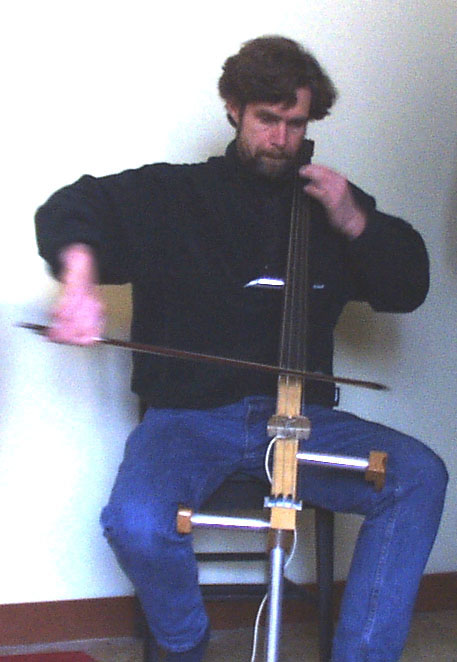
This type of composition almost completely breaches the boundary between composer and performer. Generally, “the composer creates the blueprint for a piece of music which includes software that reacts to the input of the live performer.” An example of this is Chris Chafe’s piece “Push-Pull”. He invented an interactive electronic version of the cello, known as the celletto, which has to be patched into a speaker, computer, or other electronic device to make sound. It uses a remote sensor called the “Lightning Rod”, which attaches to the performers wrist or elbow, that interprets the motion occurring inside its field and enables the synthesizer, computer, or whatever electronic device is chosen to be the “cellists” accompanist, to react. The software is able to react in real-time as if it were a person performing. Chafe used a chaos theory algorithm so every time the piece is played it is different. This blurring between reader and writer, composer and performer, is very recent and has much more room for development.
Currently blogs are already used as a medium to post established art forms like poetry, short stories, continuous stories, films, etc. But they will become their own form of art – they already are. Writing a blog is simply writing, but on-line. An excellent writer creates a work of art when they write an excellent blog. An excellent blogger combines great writing with pithiness, links, audio, and video that add to the content - but future bloggers will take this further.
Many blogs have a beautiful background or are “framed” by an image. To show an event or to help express a feeling bloggers can easily insert pictures. Some blogs are made almost entirely of pictures. Although bloggers could take a different route – instead of using the same background or .gif to ornament their blog and make it cute each different blog post could use a painting or photo, of their own or someone else’s creation, to help evoke their thoughts, moods, and feelings.
But a good writer gets their point across without using a picture; they paint with words. This is what will help differentiate between a well-written and artistic blog versus one that uses pictures and videos to substitute the mediocre written content. For a blog to be considered art in the future it will have to incorporate pictures and other multimedia. An “artistic” blog will contain original content - those written in response to another blog or that report the news will not be included in the genre.
Even when there is a new generation of writers and readers a problem exists for blogs being perceived as an art form - how temporal they are. Written and broad-casted news are not seen as an art form because they are always changing – every day the news is different. Regardless of how well written or brilliant an article is the next day it will be replaced by a new one. Blogs are similar to news because they change on a daily basis. Some political blogs are updated every few minutes.
But future generations will be used to everything being available instantaneously and changing quickly. Unless it is discovered in the future that the internet and cell phones cause caner the use of these tools will continue and become further integrated into society – new generations will have been raised with this technology. This is partly why future generations will be able to accept blogs as an art form – they will recognize that art does not have to transcend time.
Why is something only considered art unless it lasts “forever”? Paintings do not last forever; their colors fade and grime corrodes them. Statues that have been partly destroyed are considered even more artistic. Music itself is a temporal art – each note lasts for a few moments. Even recordings can only be listened to for so long. Tolstoy wrote, “Art is a human activity consisting in this, that one man consciously, by means of certain external signs, hands on to others feelings he has lived through, and that other people are infected by these feelings and also experience them.” Art is a sincere thought or feeling portrayed by the artist so that others can feel it as well. Does this portrayal have to last for some time? News is about news - it reports what happens daily, but blogs are different.
Blogs sometimes report the news, are thoughtful comments upon the news, or having nothing to do with the news at all. They should not suffer under the same stigma as the news. Blogs may be just as temporal in some instances, but the content is vastly different. Some are informative about a certain topic, offer reviews, stories, or journals, etc. There is much more room for creativity in blogging – anything can be written about and any type of media can be included. The only way a blog is limited is by dimensions and perhaps future technologies will bridge this gap (imagine a holograph to view the internet with).
The art form of blogging already exists; it is only a matter of time before it is acknowledged. Libraries can help speed up this process, if in the future they keep a record of blogs. Like pottery found on an archeological site can tell its peoples history, blogs tell ours. Examples of something similar are the Vanderbilt Television News Archive, Google News Archive, and Archive.org. Vanderbilt University has been recording news broadcasts since August 5, 1968 and loaning them to the public for a fee. Google Archive and archive.org do the same thing, only for free, with websites. They save the site and make it available after it has been removed or edited. But neither of these on-line archives has a blog section.
Libraries will make up for this shocking lack by making blogs available to search and reference through their computers and websites on-line. Similar to the Vanderbilt Project, there will be huge amounts of data to save including text, pictures, audio, and video files. If bloggers incorporate visual art into their writing, choosing between saving the entire page or just the text - simply choosing which blogs to save will be difficult. There are already millions of blogs on-line, and there is no obstacle to inhibit the creation of more as time progresses. But by using virtualized servers libraries would be able to store all the data. They could organize blogs into certain categories, and use a search crawler similar to Google’s to make searching for information fast and simple.
But which blogs should be saved? If libraries simply want to record history then it would be appropriate to save political blogs, ones about current events, and those written for a newspaper. But blogs are not simply historical, many offer information people could reference. Libraries will probably also record research blogs, ones that are informative on a certain topic, those kept by famous people, etc, so that people could search through these as well. Personal and family “journal” blogs would most likely be left out – unless if someone decided it was important to save these so that future generations could look back and see what their ancestors wrote.
By recording blogs libraries would turn them into something permanent. While blogs should not have to be permanent to be considered an art form, this will erase the problem for those who do not understand or agree. While the creation of the Vanderbilt News Archive has not made our generation consider news as an art form that is because, once again, news only reports daily occurrences. Blogs can be written about anything, and the ones that are not written about the news will have the capacity to be seen as something artistic.
Whether or not blogs are seen as art or if interactive electronic composition takes over the concert halls will all depend on the people of today. Previous generations choices shape their progeny’s society. By accepting blogs as an art form now, instead of waiting till the current readers all die, we allow future generations to toy and take these ideas even further. Help shape the future - write an artistic blog!


Subscribe to:
Post Comments (Atom)
1 comment:
It seems you have multiple definitions of reader has died, and sometimes these are a bit confusing. First paragraph is literal, second is metaphorical. You mention literal and metaphorical, but need to identify those definitions as such, so the reader can follow easily. For instance, the first paragraph should say that you can take this literally – everyone dying off who was unfamiliar with blogs – or figuratively – the roles of reader/writer have been confused. A sentence like that would make it clearer.
When you have the three paragraphs about music, is seems like a sidebar, but in the “Currently blogs are already used” paragraph, you have to address all those analogies raised in the previous music paragraphs and comment on them in order to draw the reader back into the Writing topic.
Caner isn’t so bad – but cancer might be.
The focus on blogs as art is quite good. Original and thought provoking, and you make very good rhetorical moves. However, at the end of the paper, I’d like to see how you relate the Reader is Dead idea with the Blogs as Art section. How do these two major sections of the paper unite? The Art section comes off much better than the Reader is Dead, but you have a good point with the latter.
Post a Comment